Today I was troubleshooting issues with a brand new MacBook Air that had the latest version of macOS Catalina on it. The user had installed Skype for Business but the microphone would never work. In the instructions that Microsoft provides, it says that you need to enable it in the Privacy & Security settings, however the Skype for Business Application never shows up under the Microphone settings. This went down a few rabbit holes, but what it appears is that Microsoft has not updated the Skype for Business app to update the TCC database. So what I ended up having to do was the following:
First you need to give the Terminal app full disk access, if you don’t do this, then the rest of the actions will fail. To do this, while you are in the Security and Privacy Preference Panel, find the “Full Disk Access” on the left side, once found click the lock icon to unlock if it isn’t unlocked already and then select the check box next to the Terminal application. It may give you a popup about needing to quit the terminal app because it is open, go ahead and quit the application.
Next, open a new terminal app, it is under Applications -> Utilities -> Terminal
In the Terminal app, we are going to run 2 commands, the first command is going to backup the file we will be changing with the second command. So the first command we need to run is:
4. Then we are going to run the following command which will insert a new row in to the TCC.db file (this should all be on one line):
sudo sqlite3 ~/Library/Application\ Support/com.apple.TCC/TCC.db "insert into access VALUES('kTCCServiceMicrophone','com.microsoft.SkypeForBusiness',0,1,1,NULL,NULL,NULL,'UNUSED',NULL,0,1541440109) ;"
5. Now go back to the Privacy & Security Preference Panel and click the Microphone, the Skype for Business app should show up there, as well has have a check mark next to it, if it doesn’t have the check mark, click it.
6. Then we need to remove the full disk access from Terminal, so scroll back to the Full Disk Access and uncheck the Terminal application. It will give you a popup about it running, go ahead and click the quit now.
7. Now you can either start Skype for Business, or stop and re-open it and the Microphone should work on voice calls now.
For the longest time I have been looking for a modulator that would do HD signals. I have used the standard def modulators for probably a good 25+ years and always loved making my own “cable system” in the house with various channels for different things. However with the advent of HD TV, the SD modulators were just not going to cut it for a good HD picture.
In recent years I have had a security DVR that was outputting to a SD modulator that could be viewed on any TV in the house. While it was “ok”, I always wanted the HD version of it. So one night while I was thinking of running HDMI cables from the security dvr to every TV in the house, I stumbled on VeCOAX HD Modulators from Pro Video Instruments which are $495.
Previously when I had searched for HD modulators for either ATSC or QAM the only ones that were even sort of “cheap” where from a company called ZeeVee. However, they were still a little more expensive than what I was wanting to pay with the cheapest that I saw was like around $1,200USD. So I just put up with the SD modulators until I found the VeCOAX ones.
VeCOAX has a modulator called the MiniMod-2 which will take one HDMI source and put it on any ATSC or CATV QAM channel you would like. It supports any frequency in the normal TV/CATV bands and supports ATSC to mix with OTA channels or QAM to mix with CATV channels. It also supports PSIP so you can add a 4 character label to the channel and make the channel appear as any other channel. For example, I have my modulator on CATV Channel 14, but the PSIP says it is channel 1-1.
Initially I tried to use 1080p output, but all of my TV’s (2 Samsung’s and 1 Sony) had some issues. Either the input to the modulator from the security DVR was not a clean signal or the TV’s tuners just couldn’t handle it. So there was artifacts at the top of the screen and after a few hours or more the channel would just scramble and be un-viewable until I reset the modulator.
What I ended up having to do was set the source to be 720p and then set the modulator to attenuate the signal some since it was also over-powering the tuners in the TV’s. Once I did that, the signal has been stable for a few weeks or more now.
Now the next thing to test is hooking it or another one up to a TiVO to see if it can send the TiVO signal through out the house as well. Then I may also try to do some HAM Amateur TV with it since i can set the frequency to anything.
Today I was looking at consolidating some of my various Western Digital (WD) NAS devices so I picked up one of the WD MyCloud Home 8TB “NAS” at BestBuy. TL;DR It is not a NAS device in the sense of other NAS devices they previously sold, so if you are looking for SMB, NFS, etc, it won’t do it.
Full story: Thinking that I could consolidate a few 2TB WD Live and WD MyCloud Devices on to this one 8TB device I picked it up and another 8TB USB 3 drive to connect to it. (Previous incarnations of the WD MyCloud devices have a USB port on the back that you can use to either extend the storage or “mirror” the NAS drive to it for “backups”. So I did a quick check of the specs and the new WD MyCloud Home device had a USB port. But on the box it doesn’t say it is for coping files TO the device, not “mirroring” like the previous ones.
So I got home, unboxed the new 8TB MyCloud Home device and put the MAC address in my dhcp server (yes I do IT stuff for a job, so I have static reservations for specific devices.) Then plugged in the “NAS” and it powered on. The first thing I noticed was that when I went to the Web interface on it, it just printed up a JSON error, which I thought was weird. But since I hadn’t read any of the instructions that came with it, and there was not that much that did come with it. I tried a few other URL’s and all of them gave the same error. I then pulled out the little one piece instruction card and it said I had to go to WD’s web site to set the device up. Also after reading some more, it requires a connection to WD at all times. This was a BIG no-no for me. The previous devices never needed this so why now?
Well it seems that WD has completely re-branded their MyCloud line of products. The new “Home” brand requires that you have a 64-bit version of Windows or MacOS and you have to use their software to talk to the device. So gone are the days of doing a CIFS/SMB/NFS style mount of the disk from any operating system. By the time I read this I was getting pretty mad because I had just spend over $300 for a device that I assumed would operate like the previous incarnations of the MyCloud/Live devices. Well I quickly boxed it back up and took it back to BestBuy and asked for my money back which they did do.
So if you are wanting the device to act like the old ones, and be available via SMB or NFS, etc, you need to buy one that doesn’t have “Home” in the name or go with the “Pro” or Expert line supposedly. But I think from now on I will be looking at a different vendor. I understand they want to make it easy for non-technical people. But for those who know what they are doing, they should be able to interact with the device the way they want to.
So a lot has been in the “news” lately about how Monongalia and Preston Counties in WV will be losing WBOY-TV on March 14th, 2017. Now both Comcast and WBOY have pointed fingers at each other as to why the retransmission will cease on that date. WBOY states that it’s parent owner, NexStar Media Group, is not the reason it is being dropped. Also Comcast has been a little light on the information it has provided as why it is dropping it as well.
The interesting part about it is most people (or I should say all Comcast subscribers in Mon and Preston County) should have received a letter from Comcast stating that the station will be dropped on 3/14. I received a letter, however it was not for WBOY. But for another Nexstar Station WTEM-TV in Elmira NY. The premise was the same, the station is not in the receivers DMA (Designated Market Area) and Comcast states “our business agreement with the station’s owner to cary this out-of-market broadcast station has ended.”
What this reminds me of, and everyone has experienced it with cable and satellite services, is that the owner of a station, and it doesn’t have to be broadcast stations but could also be a “cable type station”, believes that the price that the cable/satellite provider is paying them for their station isn’t what they believe it is valued at. This happens all the time, and most recently Dish Network was going to drop WBOY from DISH the Friday before the Super Bowl. So my personal opinion is now that Nexstar owns WBOY / WTEM they asked Comcast for a increase in the retransmission fees, and Comcast said no because it (the station) was not a primary DMA station. So they dropped the contract and the viewers are left “hurt”.
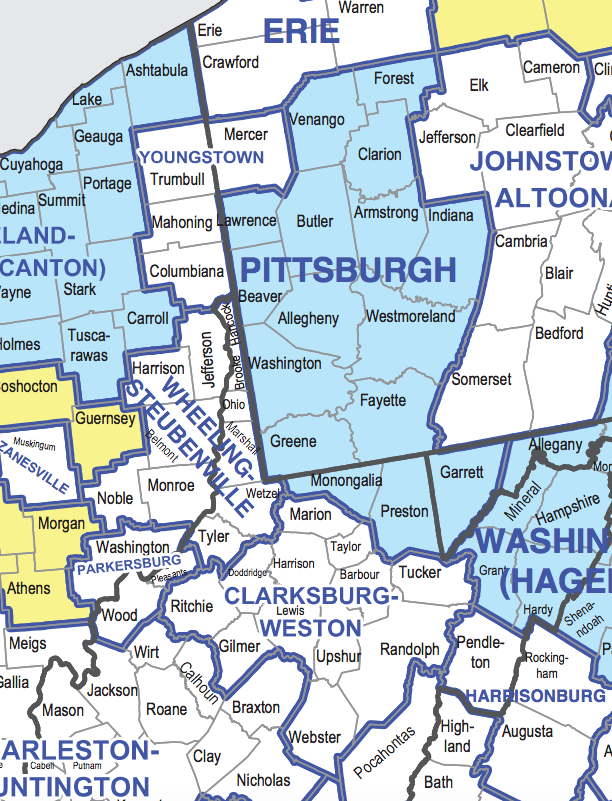
What makes it more difficult with Mon/Preston County they are in the Pittsburgh DMA. (Which I actually like because I actually prefer the Pittsburgh Broadcast stations, they seem more professional and have less mishaps like running a commercial in the middle of program when there shouldn’t be one.) But I also see the viewers point of view too. WBOY has a small studio in Morgantown and do local news for the area. Whereas the Pittsburgh channels may only do a story about the area if it is something major.
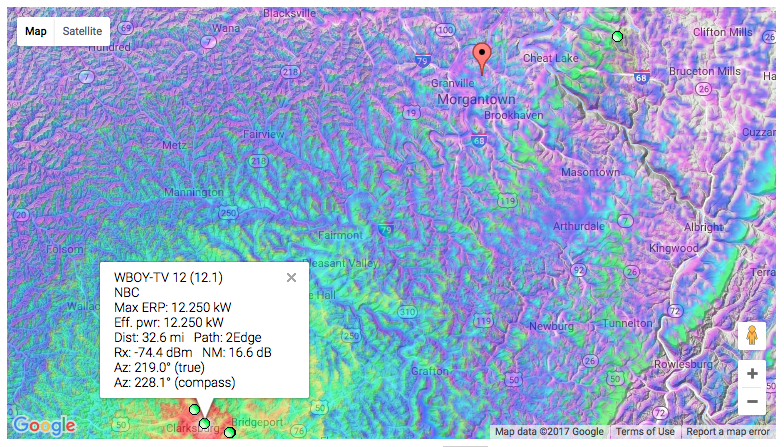
Another issue to add to it is, while WBOY is a broadcast channel, it is a weaker signal. In addition it is on VHF, which with a digital signal, propagation is severely limited especially since their power output (effective radiated) is only 12.25kW vs. say WPXI in Pittsburgh (the NBC affiliate for the Pittsburgh DMA) which broadcasts on UHF 48 at a effective radiated power of 1,000kW. Given that north central West Virginia is a dissected plateau it means you need a antenna really high and very directional to pick up channel 12 or cable/satellite provider to provide you the signal. (I also live in a valley, which means the only station I can even begin to pick up is WNPB the PBS affiliate that is in Morgantown.) So viewers who want to keep WBOY only have a couple of solutions. The first would be to see if they can receive the signal, but according to this graphic, that seems a little hard for the Morgantown area for OTA reception:
graphic from tvfool.com
As you can see by the time it hits Morgantown it is very fringe reception. Also you may not have the ability to put an antenna outside to pick it up. So the second option would be Satellite, however those people would fall back in to the Comcast scenario, since Mon and Preston are part of the Pittsburgh DMA, the satellite provider will only give you those channels and none of the off-market channels. So you are left with not seeing the channel at all.
Now some people in the counties have been trying to get Mon and Preson reclassified in to the Clarksbug DMA. (I for one don’t want to see that as I like the Pittsburgh channels better…) I however don’t see this happening as the Pittsburgh stations would then fight they are losing a major source of viewership.
So the interesting part about this area, is there are 3 “major” TV markets that are in very close proximity. The largest is the Pittsburgh DMA which includes stations (major broadcast) KDKA (CBS), WTAE(ABC), WPXI(NBC), WQED(PBS),WNPB(PBS)[technically in Pittsburgh, but also listed in Clarksburg/Weston], WPGH(FOX), WPNT(MyNetwork). The other two are smaller markets. Clarksburg/Weston has 3 broadcast stations, WDTV (CBS), WVFX(FOX/CW) and WBOY (NBC/ABC). The third is the Wheeling WV/Steubenville OH which has 2 broadcast channels, WTRF (CBS/ABC/MyNetwork) and WTOV (NBC/FOX/MeTV)
Now when I lived at home with my parents we are pretty much in the middle of all three of these markets. I actually had several antenna’s in the attic that could pick up a lot of these stations, so we had several of each broadcast network. This is where I also became a video junkie and loved doing late night DXing of stations. Now my parents can only get the Pittsburgh stations on cable, even though the area could technically receive stations from all 3 markets.
But the whole reason for this post is my speculation of what actually happened vs what is being told to the customers. In short I believe Nexstar asked Comcast to provide them more money to be able to retransmit WBOY on the Mon and Preston Counties Comcast system. Comcast said, no you are a secondary so we will just drop you. And that was it, no more negotiation, no more looking out for the best interest of the viewers of the station, just drop it. While I seldom watched WBOY, there were times that I did when major events were going on in the state and the Pittsburgh channels were not covering it. It also begs to ask that if it really was a issue with the station being out of the primary DMA, then why is Comcast keeping WDTV and WVFX since they are out of the Clarksburg/Weston Market as well. Sure people will have to switch to one of those for local news, but I guess it is better than losing all 3 stations.
I doubt that Comcast will change their mind, even though they make billions of dollars a year. But in the reality I am surprised that the stations have been carried for as long as I have been here (over 23 years).
So in my efforts to get backups of all my devices/computers and have a copy off site, I ran in to a little problem with the PS3. I went to the local Best Buy and bought a couple Seagate portable 2.5 inch USB 3 hard drives. One was a 1TB one for my PS3 and one was a 2TB one for the PS4. The PS4 immediately started working and backed up. Excellent, however the PS3 had a myriad of �issues. The first issue is that the drive has to be formatted as FAT32 for the PS3 to be able to read/write to it. Well Windows 7 won’t let you format a drive as FAT32, it only supports NTFS and exFAT (the successor to FAT32). While the PS4 can read/write exFAT the PS3 is stuck on FAT32.
Luckily I have some some Mac’s and was able to format the hard drive as FAT32. Now the PS3 recognized it and I thought my problems with the backup were over. So I started the backup and then left it run. I came back a few hours later (as it said it was going to take 4 hours to do the backup) and saw the error “Unable to access the drive.” Well crap, so I thought it was a fluke and tried to start the backup again. This time it went for about 30 minutes or so and then died again with the same error. I tried it a few more times and each time it died at different parts. Since failure is not an option, but it was getting late, I decided to stop for the evening and pick backup the next day.
On the following day I started doing some google-fu and trying to see what other people were doing for backups on the PS3. Everything I had seen I had already done with the exception of one small sentence from one post on a message board. That sentence is what actually fixed my problem. As you would note from above I bought a �USB 3.0 drive (as most are 3 now days vs the 2.) Well this was the actual issue. It appears that the PS3 USB 2.0 ports don’t have enough voltage to power a portable hard drive such as the one I bought. If the drive had external power, I wouldn’t have had the issue. So the solution was to put a powered USB hub in between the PS3 and the USB hard drive. I did that, and presto about 4 hours later the backup was done.
Hopefully this will help other people. As for the formatting of the hard drive in FAT 32, if you don’t have a Mac laying around you can download GPartd (which is a Linux ISO) which you can boot and then format the USB drive. (It is available from�http://gparted.sourceforge.net/livecd.php.)